 Yes, our little baby circle. It also seems that this little baby circle will be joining us November 10th, 2007.
Saturday, March 17, 2007
Golden Pigs, Super Sheng Bo, and a Circle
We will be having a Golden Pig! Which means we will have a baby! This year in China is the Year of the Pig which is a very auspicious year to have a baby. But this year also happens to be the Golden year of the Pig which only happens every 600 years or so. Needless to say every man, women, and Chinese animal are trying to capitalize on this lucky year. We knew of this behavior and joined the mass baby boom with excitement. In fact, we got our first dose of having a baby in China when we had to wait in line at the hospital at 7am on Sunday morning for over 90 minutes to be seen by the Chao Sheng Bo. The Chao Sheng Bo translates as (Super Sound Machine) or ultra-sound. Yes, in Kunming there is no system of appointments or reservations so in order to beat the hundreds of other women needing an ultra sound, you have to show up early...real early. The experience was much like the life of a trader on wall street as we wave our forms amidst 50 other other women all clamoring for the attention of the doctor. Eventually our order got taken and we were whisked into the Ultra-sound room to have a look at what you see below.
 Yes, our little baby circle. It also seems that this little baby circle will be joining us November 10th, 2007.


Wednesday, March 14, 2007
Blogging a la Kunming
We are back! After hours and hours of flying we are back home in Kunming. One especially memorable event was getting to again experience China Eastern Airline's state-of-the-art bucket seats. You must take the next opportunity to truly feel the luxurious comfort of a airline seat that feels literally like you are sitting on a open bucket. I believe it was at least a Top 5 new invention in 1942.
We got back into the full swing of things this week. On Tuesday, we both started classes at our new school with much excitement. Learning Chinese 1-on-1 is simply phenomenal. We highly recommend this school because they take teaching us Chinese very seriously.
Liz is back teaching dance again to the tune of 8 classes a week: Ballet, Jazz, and Funk. There is an overwhelming demand for her classes that we have only begun to tap. We decided to hold off on starting our own studio or partnering with Nordica for the time being because neither option was very attractive or feasible at this juncture. We continue to seek His guidance on how to pursue that avenue for her.
I, Chris, am working at a local private English school to develop an advanced oral English course. It will start as a weekly 3 hour course on Sundays for high school students. We will see where it goes from there. I also had the chance to teach a Lisu minority man how to use the computer for the first time today. I realized how much I take the computer for granted when this relatively young man had never even turned one on before. I was so amazed when I shouldn't really be. I was impressed though by the fishing motion he developed with the mouse. It was quite a strategy for getting the cursor to move across the screen. The hope is that a few of these Lisu people can learn how to use the computer so they can access the wealth of knowledge and resources that the internet offers to help supplement their lack of resources in the villages.
Friday, March 2, 2007
Coffee the new black in China
Is coffee the new black?
By Erik Nilsson (China Daily)Updated: 2007-03-02 10:40
China might be known for its tea traditions, but today, it's brewing an increasingly sophisticated coffee culture.
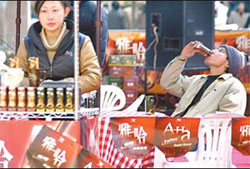
As a growing number of Chinese develop a taste for the traditionally Western beverage, their knowledge of coffee is becoming more complex.
"There is a greater awareness of coffee in China than then we first started selling it in China," said managing director of Arabica Coffee Roasters Stuart Eunson.
Having helped shape the culture in its early days, Eunson knows well how far China's coffee culture has come since Arabica first entered the Chinese market in 1994.
"In 1994, Beijing taxi drivers didn't know what coffee was," Eunson said. He recalls that when he would respond to cabbies' inquiries about what he was doing in China, "They'd say, 'we've heard of coffee. What is it exactly'?"
They were familiar with the word and with the marketing, but not with the product.
However, it didn't take long for a fledgling coffee culture to percolate into urban Chinese life.
"In less than a decade, it went from taxi drivers in Beijing not knowing what coffee was, to it becoming part of the colloquialism," Eunson said.
The speed at which Chinese took to coffee is demonstrated by the 90 percent increase in total volume sales in China between 1998 and 2003, when it reached 6,504.5 tons. Demand for coffee more than doubled between 2001 and 2006 and is currently estimated to be growing by 10 percent a year, according to the International Coffee Organization (ICO).
To read the rest of this article, go to to this link.
Subscribe to:
Posts (Atom)